
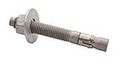


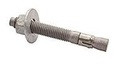


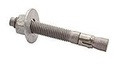
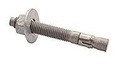

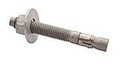
Specifications
- Type: wedge (stud) expansion anchor with hex nut and washer
- Material: carbon steel, hot-dip galvanized per ASTM A153, with a Type 304 stainless steel clip
- Diameters: 1/4" to 1-1/4", 41 sizes in stock
- Hole size: same as the anchor diameter
- Base materials: solid concrete, grout-filled block and hard stone (not hollow block or brick)
- Length code stamped on the end of each anchor
- Use: outdoor and damp locations, pressure-treated lumber
Sizes in Stock
- 1/4" diameter (1/4" drill bit, 1/4-20 thread, 1-1/4" min. embedment): 1-3/4", 2-1/4", 3-1/4" long
- 3/8" diameter (3/8" drill bit, 3/8-16 thread, 1-3/4" min. embedment): 2-1/4", 2-3/4", 3", 3-3/4", 5", 7" long
- 1/2" diameter (1/2" drill bit, 1/2-13 thread, 2-1/8" min. embedment): 2-3/4", 3-3/4", 4-1/4", 5-1/2", 7", 8-1/2", 10" long
- 5/8" diameter (5/8" drill bit, 5/8-11 thread, 2-5/8" min. embedment): 3-1/2", 4-1/4", 4-1/2", 5", 6", 7", 8-1/2", 10", 12" long
- 3/4" diameter (3/4" drill bit, 3/4-10 thread, 3-1/4" min. embedment): 4-1/4", 4-3/4", 5-1/2", 6-1/4", 7", 8-1/2", 10", 12" long
- 7/8" diameter (7/8" drill bit, 7/8-9 thread, 3-7/8" min. embedment): 6", 8", 10" long
- 1" diameter (1" drill bit, 1-8 thread, 4" min. embedment): 6", 9", 12" long
- 1-1/4" diameter (1-1/4" drill bit, 1-1/4-7 thread, 5-5/8" min. embedment): 9", 12" long
How to Install a Wedge Anchor
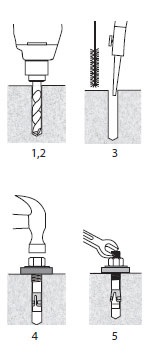
- Drill the hole. Use a carbide-tipped masonry bit meeting ANSI B212.15, the same diameter as the anchor (a 1/2" anchor takes a 1/2" bit). Drill perpendicular to the surface; you can drill straight through the fixture. Do not ream the hole or let the drill wobble.
- Clean the hole. Blow out the dust with compressed air, brush it with a nylon brush, then blow it out again. Dust left in the hole lowers the holding power.
- Check the depth. Drill at least 1/2" deeper than the embedment so the anchor can go in fully, but no closer than two anchor diameters to the bottom surface of the concrete.
- Drive the anchor. Thread the nut on flush with the end of the anchor, with the washer under it, to protect the threads. Put the anchor through the fixture and hammer it in until the washer is tight against the fixture and the anchor reaches at least the minimum embedment.
- Tighten the nut. Tighten 3 to 5 turns past hand-tight, or to the setting torque in the table below with a torque wrench. This pulls the cone up into the clip and wedges it against the hole. Do not over-tighten.
Step-by-step pictures, every stock number and the minimum embedment for each size are in the Hot-Dip Galvanized Wedge Anchors Installation Instructions (PDF). The same sheet also lists material specifications and ultimate and allowable load values.
Installation Data
| Anchor Dia. | Drill Size | Thread (UNC) | Wrench Size | Min. Embedment | Setting Torque (ft-lbs) | Min. Edge Distance | Critical Edge Distance |
|---|---|---|---|---|---|---|---|
| 1/4" | 1/4" | 1/4-20 | 7/16" | 1-1/4" | 4–8 | 1-1/4" | 3" |
| 3/8" | 3/8" | 3/8-16 | 9/16" | 1-3/4" | 20–25 | 1-7/8" | 4-1/2" |
| 1/2" | 1/2" | 1/2-13 | 3/4" | 2-1/8" | 40–50 | 2-1/2" | 6" |
| 5/8" | 5/8" | 5/8-11 | 15/16" | 2-5/8" | 80–90 | 3-1/8" | 7-1/2" |
| 3/4" | 3/4" | 3/4-10 | 1-1/8" | 3-1/4" | 145–155 | 3-3/8" | 9" |
| 7/8" | 7/8" | 7/8-9 | 1-5/16" | 3-7/8" | 220–230 | 4-3/8" | 10-1/2" |
| 1" | 1" | 1-8 | 1-1/2" | 4" | 255–280 | 5" | 12" |
| 1-1/4" | 1-1/4" | 1-1/4-7 | 1-7/8" | 5-5/8" | 390–400 | 6-1/4" | 15" |
Drill size equals the anchor diameter. Setting torque is for normal-weight concrete. Minimum spacing between anchors equals the embedment depth; for full load space anchors 2 embedment depths apart and use the critical edge distance. Design loads must be calculated by a qualified engineer.
Choosing the Anchor Length
Anchor length = minimum embedment + fixture thickness + nut and washer thickness (about one anchor diameter). Example: a 1/2" anchor through a 1/2" steel plate is 2-1/8" + 1/2" + 1/2" = 3-1/8", so use the next longer stock length, 3-3/4". A longer anchor gives deeper embedment and more holding power.
Common Uses
- Structural steel columns, beams and ledgers
- Machinery and equipment bases
- Racking, shelving and storage systems
- Handrails, guardrails and stair stringers
- Docks, seawalls and outdoor structures
- Signs, poles and light bases
FAQ
What size drill bit do I use for a wedge anchor?
The drill bit is the same size as the anchor. A 1/2" wedge anchor takes a 1/2" bit. Use a carbide-tipped masonry bit that meets ANSI B212.15.
How deep do I drill the hole?
Drill at least 1/2" deeper than the embedment you plan to use. Minimum embedment runs from 1-1/4" for 1/4" anchors to 5-5/8" for 1-1/4" anchors; every size is listed in the table above and in the installation instructions PDF.
How do I choose the anchor length?
Add the minimum embedment, the thickness of the material you are fastening, and the nut and washer (about one anchor diameter). Example: a 1/2" anchor through a 1/2" plate is 2-1/8" + 1/2" + 1/2" = 3-1/8", so use the next longer stock length, 3-3/4".
Can wedge anchors be used in brick or hollow block?
No. Wedge anchors are for solid concrete, grout-filled block and hard stone. For brick and hollow block use hex sleeve anchors.
How tight should a wedge anchor be?
Tighten the nut 3 to 5 turns past hand-tight, or to the setting torque for the diameter (for example 20-25 ft-lbs for 3/8" and 40-50 ft-lbs for 1/2"). Over-tightening can damage the anchor or crack the concrete.
What do the letters stamped on the end of the anchor mean?
The letter is the length code, so the length can be checked after the anchor is installed. The code chart is on page 2 of the installation instructions PDF.
When should I use galvanized wedge anchors?
Use hot-dip galvanized wedge anchors outdoors, in damp locations and with pressure-treated lumber. For dry indoor work zinc plated costs less; for salt water and chemicals use 18-8 stainless steel.
Also see Wedge Anchors - Zinc Plated Steel | Wedge Anchors - 18-8 Stainless Steel | Hex Sleeve Anchors | All Concrete Anchors
Free shipping on orders over $100, and orders placed before noon EST ship the same day. Purchase orders are accepted from government agencies, schools, hospitals, municipalities and companies with established credit with The Nutty Company, Inc.