



-
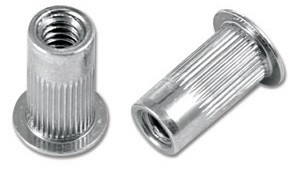 $0.370each
Specifications
- Type: large flange, ribbed body, open end
- Material: aluminum alloy (5056), plain finish, RoHS compliant
- Threads: ISO metric coarse, Class 6H – M4 x 0.7, M5 x 0.8, M6 x 1.0, M8 x 1.25, M10 x 1.5
- Drill sizes: 6.75 mm (M4), 7.6 mm (M5), 10.0 mm (M6), 13.5 mm (M8 and M10)
How to Choose
- Thread size: match the bolt or screw you will use.
- Grip range: add up the thickness of all the material being joined. Each size comes in a short (S) and long (L) grip – pick the one whose range includes your thickness. Example: M6 short grip fits 0.7–4.2 mm (.028"–.165"), long grip fits 4.2–6.6 mm.
- Material: aluminum rivet nuts are light and corrosion resistant, and best in aluminum and softer materials. For more strength, use metric steel ribbed rivet nuts.
How to Install
- Drill the hole to the drill size on the Data Sheet (PDF) and deburr it.
- Thread the rivet nut onto the mandrel of a rivet nut tool until the flange sits against the nosepiece.
- Push it into the hole until the flange is flat on the panel.
- Squeeze the tool. The body collapses behind the panel and locks the rivet nut in place.
- Unscrew the mandrel and attach your part with a bolt or screw of the same thread. Do not over-tighten.
Use the right mandrel and nosepiece for each thread size. Use metric mandrels. A heavy-duty hand tool or pneumatic tool works best for M8 and M10. See our rivet guns and rivet nut tools.
Common Uses
- Sheet metal enclosures, panels and cabinets
- Aluminum tube, extrusions and frames
- Truck bodies, trailers and RVs
- Boats, docks and marine accessories (aluminum)
- Signs, lighting and electrical boxes
- Fiberglass and plastic panels
FAQ
What is a ribbed rivet nut?
A rivet nut with ribs (splines) on the body. The ribs bite into the hole wall, so the rivet nut resists spinning when a bolt is tightened or removed.
What size hole do I drill for a rivet nut?
6.75 mm for M4, 7.6 mm for M5, 10.0 mm for M6, and 13.5 mm for M8 and M10. Exact hole ranges are on the Data Sheet (PDF).
What does grip range mean?
The total thickness of the material the rivet nut can hold. Pick the short (S) or long (L) grip whose range includes your material thickness.
Do I need access to the back side?
No. Rivet nuts install from one side with a hand or pneumatic rivet nut tool, so they work in tube, closed sections and panels you cannot reach behind.
Related: Steel Ribbed Rivet Nuts - Metric Sizes | Aluminum Ribbed Rivet Nuts - U.S. Sizes | Aluminum Flat Head Rivet Nuts - U.S. Sizes | Rivet Guns
Free shipping on orders over $100, and orders placed before noon EST ship the same day. Purchase orders are accepted from government agencies, schools, hospitals, municipalities and companies with established credit with The Nutty Company, Inc.