
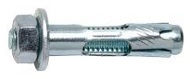


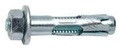


Specifications
- Type: hex nut sleeve anchor, pre-assembled with hex nut and washer
- Material: carbon steel, zinc plated
- Diameters: 1/4" to 3/4", 18 sizes in stock
- Hole size: same as the anchor diameter
- Base materials: concrete, grout-filled block, hollow block, brick and stone
- Use: dry, indoor locations
Sizes in Stock
- 1/4" diameter (1/4" drill bit, 10-24 bolt thread): 1-3/8", 2-1/4" long
- 5/16" diameter (5/16" drill bit, 1/4-20 bolt thread): 1-1/2", 2-1/2" long
- 3/8" diameter (3/8" drill bit, 5/16-18 bolt thread): 1-7/8", 3", 4" long
- 1/2" diameter (1/2" drill bit, 3/8-16 bolt thread): 2-1/4", 3", 4", 6" long
- 5/8" diameter (5/8" drill bit, 1/2-13 bolt thread): 2-1/4", 3", 4-1/4", 6" long
- 3/4" diameter (3/4" drill bit, 5/8-11 bolt thread): 2-1/2", 4-1/4", 6-1/4" long
How to Install a Hex Sleeve Anchor
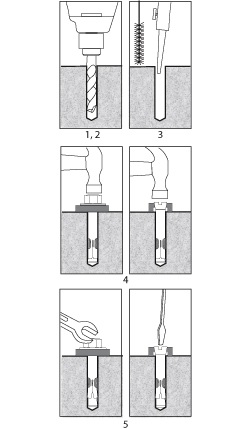
- Drill the hole. Use a carbide-tipped masonry bit meeting ANSI B212.15, the same diameter as the anchor (a 3/8" anchor takes a 3/8" bit). Drill perpendicular to the surface, through the hole in the fixture. Do not ream the hole or let the drill wobble.
- Clean the hole. Blow out the dust with compressed air, brush it with a nylon brush, then blow it out again. A clean hole is needed for full holding power.
- Check the depth. Drill at least one anchor diameter deeper than the minimum embedment, but no closer than two anchor diameters to the bottom surface of the concrete. In hollow block you may drill through; the sleeve must expand in the solid part of the block.
- Drive the anchor. Leave the nut and washer on. Tap the anchor through the fixture into the hole until the washer sits tight against the fixture.
- Tighten the nut. Turn the nut 3 to 5 turns past hand-tight, or to the installation torque in the table below. This pulls the cone into the sleeve and expands it against the hole. Do not over-tighten.
Step-by-step pictures, every stock number and the minimum embedment for each size are in the Hex Sleeve Anchor Installation Instructions (PDF).
Installation Data
| Anchor Dia. | Drill Size | Bolt Thread | Min. Embedment | Install Torque (ft-lbs) | Min. Edge Distance | Min. Spacing |
|---|---|---|---|---|---|---|
| 1/4" | 1/4" | 10-24 | 1-1/8" | 4 | 1-1/4" | 1-11/16" |
| 5/16" | 5/16" | 1/4-20 | 1-3/16" | 8 | 1-1/2" | 2-3/16" |
| 3/8" | 3/8" | 5/16-18 | 1-1/4" | 15 | 1-3/4" | 2-1/4" |
| 1/2" | 1/2" | 3/8-16 | 1-1/2" | 25 | 2-1/4" | 3-3/8" |
| 5/8" | 5/8" | 1/2-13 | 2" | 55 | 3-1/8" | 4-1/8" |
| 3/4" | 3/4" | 5/8-11 | 2-1/4" | 90 | 3-3/4" | 5-1/16" |
Torque is for normal-weight concrete. Minimum edge and spacing distances are for reduced loads; for full load allow 12 anchor diameters from an edge and 3 embedment depths between anchors. Design loads must be calculated by a qualified engineer.
Choosing the Anchor Length

Anchor length = minimum embedment + material thickness + nut height (the nut height equals the anchor diameter). Example: a 3/8" anchor through a 1/4" plate is 1-1/4" + 1/4" + 3/8" = 1-7/8". If the total falls between stock lengths, choose the next longer one.
Common Uses
- Shelving, racks and storage systems
- Door and window frames
- Handrails and railings
- Sill plates and ledgers
- Electrical boxes, conduit straps and cable tray
- Signs, brackets and light fixtures
FAQ
What size drill bit do I use for a sleeve anchor?
The drill bit is the same size as the anchor. A 3/8" sleeve anchor takes a 3/8" bit and a 1/2" anchor takes a 1/2" bit. Use a carbide-tipped masonry bit that meets ANSI B212.15.
Why is the bolt thread smaller than the anchor size?
The anchor size is the outside diameter of the sleeve, which is also the drill size. The threaded stud inside is one size smaller, for example 5/16-18 on a 3/8" anchor and 3/8-16 on a 1/2" anchor.
How do I choose the anchor length?
Add the minimum embedment, the thickness of the material you are fastening, and the nut height (equal to the anchor diameter). Example: a 3/8" anchor through a 1/4" plate is 1-1/4" + 1/4" + 3/8" = 1-7/8". If the total falls between lengths, choose the next longer one.
Can sleeve anchors be used in brick and block?
Yes. Sleeve anchors work in solid concrete, grout-filled and hollow block, brick and stone. In hollow block you may drill through, but the sleeve must expand in the solid part of the block.
How tight should a sleeve anchor be?
Tighten the nut 3 to 5 turns past hand-tight, or to the installation torque listed for the diameter (for example 15 ft-lbs for 3/8" and 25 ft-lbs for 1/2"). Over-tightening can spin the anchor or crack the base material.
Can I use plated sleeve anchors outdoors?
Zinc plated sleeve anchors are for dry, indoor locations. For outdoor, wet, marine or corrosive locations, use our 18-8 stainless steel hex sleeve anchors.
Also see Hex Sleeve Anchors - Stainless Steel | Flat Head Sleeve Anchors | Wedge (Stud) Anchors | All Concrete Anchors
Free shipping on orders over $100, and orders placed before noon EST ship the same day. Purchase orders are accepted from government agencies, schools, hospitals, municipalities and companies with established credit with The Nutty Company, Inc.