
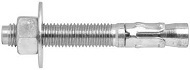






Stud Anchor Bolts (also known as Wedge Anchors or Quick-Bolts) are used for securing items to Solid Concrete.
When the nut is tightened against the washer (or item being mounted), this action pulls the concrete stud
anchor up and the tapered end expands the sleeve section, wedging it tightly against the sides of the hole.
The hole diameter required is the same as the diameter of the Stud Anchor being used.
Stud Anchors are available in Plated Steel, Galvanized Steel, 18-8 Stainless Steel and 316 Stainless Steel.
Installation Instructions
|
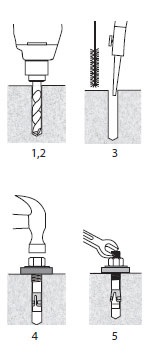
1. Drill the hole, whose diameter equals the anchor diameter, perpendicular to the work surface. To assure full holding power, do not ream the hole or allow the drill to wobble. Drill the hole deeper than the intended embedment, but not closer than two diameters to the opposite surface of the concrete. |
|
2. A clean hole is necessary for proper performance. Clean the hole using a nylon brush and compressed air. |
|
3. Assemble the nut and washer onto the anchor. Drive the anchor through the material to be fastened at the calculated embedment depth. |
|
4. Tighten the nut, or head, 3 to 5 turns past the hand tight position. Installing with a torque wrench is recommended for optimum performance. Refer to Recommended Setting Torque* in the table below. |
|
Anchor Dia. (in.) |
Drill Bit Dia. (in.) |
Fixture Clearance Hole (in.) |
Thread Size (UNC) |
Nut Height (in.) |
Washer Diameter (in.) |
Wrench Size (in.) |
Recommended Setting Torque (ft-lbs)* |
||
|
Zinc & Galvanized |
Stainless Steel |
W/O Inspection Turns to Set |
|||||||
|
1/4 |
1/4 |
5/16 |
1/4-20 |
7/32 |
5/8 |
7/16 |
6-8 |
4-8 |
3-5 |
|
3/8 |
3/8 |
7/16 |
3/8-16 |
21/64 |
13/16 |
9/16 |
20-25 |
20-25 |
3-5 |
|
1/2 |
1/2 |
9/16 |
1/2-13 |
7/16 |
1-1/16 |
3/4 |
50-55 |
40-50 |
3-5 |
|
5/8 |
5/8 |
11/16 |
5/8-11 |
35/64 |
1-3/4 |
15/16 |
90-95 |
80-90 |
3-5 |
|
3/4 |
3/4 |
13/16 |
3/4 -10 |
41/64 |
2 |
1-1/8 |
165-175 |
145-155 |
3-5 |
|
7/8 |
7/8 |
15/16 |
7/8-9 |
3/4 |
2-1/4 |
1-5/16 |
240-250 |
220-230 |
3-5 |
|
1 |
1 |
1-1/8 |
1-8 |
55/64 |
2-1/2 |
1-1/2 |
290-300 |
255-280 |
3-5 |
|
1-1/4 |
1-1/4 |
1-3/8 |
11/4-7 |
1-1/16 |
3 |
1-7/8 |
400-410 |
390-400 |
3-5 |
Common Uses
- Ledgers, railings and posts on concrete
- Machinery, racks and equipment
- Outdoor structures on slabs and walls
FAQ
What drill bit do I use?
A carbide bit the same diameter as the anchor: 1/2" for a 1/2" anchor, for example.
Can stud anchors be used in block or brick?
Stud anchors are made for solid concrete. For hollow block or brick, use concrete power screws or another anchor rated for masonry.
Related: Galvanized Concrete Power Screws | Galvanized L Anchors
Free shipping on orders over $100, and orders placed before noon EST ship the same day. Purchase orders are accepted from government agencies, schools, hospitals, municipalities and companies with established credit with The Nutty Company, Inc.
Stud Anchor Bolts (also known as Wedge Anchors or Quick-Bolts) are used for securing items to Solid Concrete.
When the nut is tightened against the washer (or item being mounted), this action pulls the concrete stud
anchor up and the tapered end expands the sleeve section, wedging it tightly against the sides of the hole.
The hole diameter required is the same as the diameter of the Stud Anchor being used.
Stud Anchors are available in Plated Steel, Galvanized Steel, 18-8 Stainless Steel and 316 Stainless Steel.