


Choose a Type
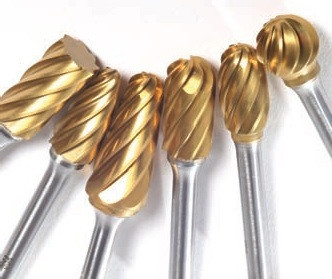
- Double Cut Carbide Burs – chisel-type teeth with left- and right-hand spirals for fast stock removal, a fine finish and good control in steels, stainless, cast iron and titanium.
- Non-Ferrous Carbide Burs – open, aggressive flutes that clear chips and resist loading in aluminum, copper, brass, zinc and magnesium.
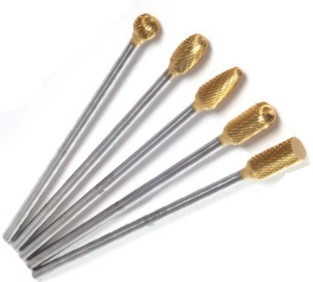
- X-Long Double Cut Carbide Burs – 6" long shanks for deep, hard-to-reach work such as engine blocks and ports.
- Carbide Bur Sets – 8-piece TiN coated kits.
Shapes
- SA Cylinder – deburring, removing welds, flat surfaces.
- SC Cylinder Radius End – surface milling and contouring, inside corners with a radius.
- SD Ball – contouring, hollowing, hole deburring and milling.
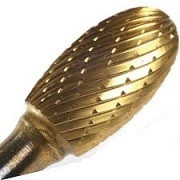
- SE Oval – contouring and rounding edges.
- SF Tree Radius End – work on narrow contours and rounded concave cuts.
- SG Tree Pointed End – Narrow contours, acute-angle areas and milling.
- SL 14° Taper Radius End – Narrow contours, deep slots and surface machining.
- SM Cone – Narrow contours, countersinking and chamfering.
Which Cut for Which Material
| Material | Double Cut | Non-Ferrous |
|---|---|---|
| Aluminum | – | ✓ |
| Brass | ✓ | ✓ |
| Bronze | ✓ | – |
| Cast iron | ✓ | – |
| Copper | – | ✓ |
| Carbon fiber | – | ✓ |
| Fiberglass | ✓ | – |
| Inconel | ✓ | – |
| Magnesium | – | ✓ |
| Plastics | ✓ | – |
| Hard rubber | ✓ | – |
| Steel 45–55 Rc | ✓ | – |
| Steel 55–60 Rc | ✓ | – |
| Steel – carbon | ✓ | – |
| Steel – nickel chrome | ✓ | – |
| Steel – stainless | ✓ | – |
| Steel – weldments | ✓ | – |
| Titanium | ✓ | – |
| Zinc | – | ✓ |

 Watch carbide burs in action (video)
Tips
- Use an air or electric die grinder – never a portable drill.
- Slower speeds for harder materials and long-shank burs; higher speeds for small burs.
- Light, constant pressure with a steady sweeping motion. Let the bur do the cutting.
- Do not use worn tools or collets – they cause chatter and chipping. Wear safety glasses.
FAQ
Double cut or non-ferrous?
Double cut burs are for steel, stainless, cast iron, titanium and other hard metals. Non-ferrous burs have open flutes that do not load up in aluminum, copper, brass, zinc and magnesium.
Which shape do I need?
Cylinders (SA, SC) for flat surfaces and edges, ball (SD) and oval (SE) for contours and hollows, tree (SF, SG) and taper (SL) for narrow contours and slots, cone (SM) for countersinking and chamfers.
What speed should I run a carbide bur?
Use a die grinder, not a drill. As a guide, a 1/4 in. bur runs 30,000 to 50,000 RPM, a 3/8 in. bur 20,000 to 40,000 RPM and a 1/2 in. bur 15,000 to 40,000 RPM. Run slower in harder materials and with long-shank burs. The full speed chart is on the Data Sheet (PDF).
Can I use a carbide bur in a drill?
No. Portable drills run much too slowly for carbide burs and can cause chipping. Use an air or electric die grinder.
Related: Double Cut Carbide Burs | Non-Ferrous Carbide Burs | X-Long Double Cut Carbide Burs | Carbide Bur Sets | All Carbide Burs | Contact us
Free shipping on orders over $100, and orders placed before noon EST ship the same day. Purchase orders are accepted from government agencies, schools, hospitals, municipalities and companies with established credit with The Nutty Company, Inc.