


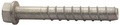
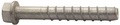
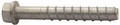


Features
- Mechanically galvanized to ASTM B695 Class 65, Type 1 for better corrosion resistance
- One-piece hex washer head with locking serrations that resist vibration and shock
- Hardened, self-tapping undercut threads need low installation torque
- Same-size hole as the screw, using a standard ANSI masonry bit – no metric or odd-size bits
- No expansion forces, so anchors can be set closer to edges and to each other
- Removable and reinstallable – ideal for temporary anchoring and equipment that needs service
- For normal-weight and lightweight concrete and solid masonry; may be suitable for hollow masonry
Galvanized or Zinc Plated?
- Zinc plated (PSZ): for dry, indoor locations. Load data per ICC-ES ESR-4414 for cracked and uncracked concrete.
- Mechanically galvanized (PS): a heavier coating for damp and outdoor exposure, and the only finish we stock in 1/4".
How to Install

1. Drill • 2. Clean • 3. Set embedment • 4. Drive to torque
- Drill a hole the same diameter as the screw with a carbide masonry bit (ANSI B212.15). Drill at least 1/2" deeper than the embedment you need.
- Clean the hole with a nylon brush and compressed air, a hand pump or a vacuum.
- Drive the screw through the fixture with an impact wrench or socket wrench until the washer head is snug against the fixture. Start an impact wrench on a light setting and do not over-torque.
- Concrete block (CMU): hand-tighten with a socket wrench only – do not use an impact wrench.
Choosing the Length
Screw length = fixture thickness + embedment depth. Example: a 1/2" screw through a 1/2" steel plate with 3" of embedment needs 3-1/2", so choose the next longer stock length, 4". Deeper embedment gives more holding power. Minimum embedment, maximum torque and load values for every size are in the data sheet.
Common Uses
- Pallet racking, shelving and conveyors
- Railings, handrails and guardrails
- Sill plates, ledgers and wood-to-concrete connections
- Machinery, equipment and signs
- Stadium seating
- Formwork and tilt-up braces (temporary anchoring)
FAQ
What size drill bit do I use for a galvanized power screw?
The same size as the screw: 1/4" bit for 1/4", 3/8" for 3/8", and so on, using a carbide masonry bit meeting ANSI B212.15.
What socket size do I need?
7/16" for 1/4", 9/16" for 3/8", 3/4" for 1/2", 15/16" for 5/8" and 1-1/8" for 3/4" screws.
How close to an edge can I install one?
Minimum edge distance is 3 screw diameters (3/4" for 1/4" up to 2-1/4" for 3/4") at reduced load. Full load needs 8 diameters in tension and 12 in shear; adjustment factors are in the data sheet.
Can I use them in concrete block?
Yes. In block (CMU), hand-tighten with a socket wrench; do not use an impact wrench.
Can galvanized power screws be reused?
Yes. They can be removed and reinstalled, which makes them a good choice for formwork, braces and other temporary anchoring.
Related: Galvanized Power Screws (Concrete Anchors) | Zinc Plated Power Screws | Galvanized Concrete Stud Anchors | Galvanized Fasteners
Free shipping on orders over $100, and orders placed before noon EST ship the same day. Purchase orders are accepted from government agencies, schools, hospitals, municipalities and companies with established credit with The Nutty Company, Inc.